How to Optimise for Perplexity

Perplexity is the AI search tool most UK businesses ignore and the one they should probably look at first.
It has a smaller audience than ChatGPT and a fraction of Google’s reach, so on volume alone it looks like a minor concern. That misses the point. Perplexity cites every source it uses, visibly, on every answer. It is the only one of these systems that consistently shows its working.
That makes it the best diagnostic instrument available to you, and a genuine visibility channel in its own right. This article covers how it differs from the others, how to get cited, and how to read what it shows you.
How Is Perplexity Different from ChatGPT and Google?
Three differences that change what you do.
It is built as a search engine, not a chatbot with search bolted on
Perplexity retrieves first and composes afterwards. Almost every answer is assembled from live sources rather than from training data. That means what it says about your business reflects the web as it is now, not as it was when a model was trained, and work you do this month can show up quickly.
It cites everything, in numbered order
Every claim carries a numbered citation you can click. For anyone trying to understand how their category is being covered, this is enormously valuable. You are not guessing at which sources shape the answer. You are being shown them.
It leans towards recent and specific sources
In our experience Perplexity favours recent material more heavily than the others, and it reaches for sources that state things plainly. It will frequently cite a well-structured smaller site over a vague page on a large one, which is why it is a realistic target for businesses that cannot compete on domain authority.
Why Should I Care About a Smaller Platform?
Four reasons, and only one of them is about traffic.
- It shows you the sources. Run your buyer questions through it and you get a list of the domains shaping your category. That list is the most actionable output of any AI visibility exercise, and no other assistant hands it to you so readily.
- It is winnable. Very few UK businesses are optimising for it. The competition for citation is thinner than on Google by a wide margin.
- It predicts the others. The signals that get you cited in Perplexity, clear structure, specific claims, recency and corroboration, are the same ones the other assistants reward. If you are being cited here and nowhere else, you are usually early rather than wrong.
- Its users are researching seriously. People choose Perplexity deliberately, usually when they want sources rather than a quick answer. That is a considered buyer at the research stage, which is the visitor most worth having.
How Do I Find Out Where I Stand?
Fifteen minutes and you will know more than most of your competitors do about themselves.
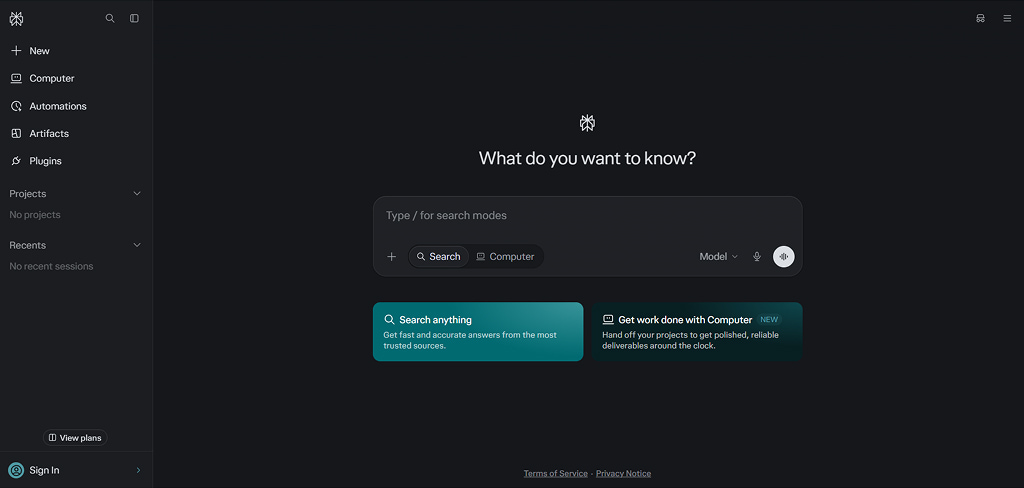
Open Perplexity in a logged-out window and run the questions your buyers ask, without naming your company. Then read three things on every answer.
- Are you named? And if not, who is.
- Which sources are cited, in order. Click them. This is the map of where authority in your category lives.
- How the cited passages are written. Look at the actual sentences it pulled. You will notice a pattern quickly, and it is almost always specificity.
That third point is the one people skip and it is the most instructive. Read four or five cited passages in your industry and the recipe becomes obvious: direct answers, plain sentences, concrete numbers, no throat-clearing.
What Gets Cited by Perplexity?
Six characteristics, in rough order of how strongly we see them.
- A direct answer near the top of the page. If the answer to the page’s question appears in the first two sentences under a clear heading, it is far more likely to be lifted.
- Specific, checkable facts. Numbers, dates, timeframes, prices, quantities. Perplexity is assembling a factual answer with citations attached, so it needs things that can be stated as facts.
- Recency. It leans towards current material more than the other assistants. A visible, honest publication or update date matters here more than anywhere else.
- Clean structure. Headings phrased as questions, short paragraphs, lists and tables. Tables in particular get lifted often, because they are unambiguous.
- Independent corroboration. Where a claim appears in more than one place, it is safer to cite. Trade press and industry publications carry disproportionate weight.
- Clear authorship. A named author with credentials makes a source easier to trust and easier to attribute.
None of that is unique to Perplexity, which is the reassuring part. Work done for it is not wasted elsewhere, and we cover the wider picture in what is generative engine optimisation.
What Should I Actually Change on My Site?
Six things, ordered by speed.
- Check Perplexity’s crawler can reach you. PerplexityBot should not be blocked in robots.txt, and your firewall should not be refusing it at the server. Ask your host to confirm it is receiving normal responses in the logs, because this catches more sites than people expect.
- Put the answer first on every important page. Question as the heading, answer in the next two sentences, explanation underneath. This is editing rather than writing and it is the fastest content change available.
- Add dates and keep them honest. Visible published and updated dates. Refresh genuinely rather than changing a timestamp, because thin refreshes are transparent and the systems are improving at spotting them.
- Convert your best explanations into tables. Comparisons, specifications, options, pricing bands. Tables are lifted disproportionately often because they cannot be misread.
- Add three checkable facts to each main page. Replace the vaguest claims you have. This is the hardest change culturally and the one that moves things most.
- Name your authors and add Person schema. Credentials, role, and a link to a real profile.
How Do I Measure It?
Better than for any other assistant, because the citations are visible.
Run a fixed set of six to eight buyer questions monthly, in a logged-out session, and record four things: whether you were named, who else was, which sources were cited and in what order, and whether any of your own pages appeared in the citation list.
That last column is your scoreboard. The month your own pages start appearing in the citations for questions you did not name yourself in is the month the work started paying. It is a far clearer signal than anything you will get from ChatGPT, which frequently answers without showing you why.
Keep it in a spreadsheet. How to check if AI recommends your business sets out the full method and the exact prompts.
Does Perplexity Send Real Traffic?
Yes, in modest volumes, and it is usually excellent traffic.
Because every answer carries visible citations, people click them more readily than they click through from an assistant that simply asserts things. Someone arriving from a Perplexity citation has seen your name attached to a specific claim and chosen to check the source, which is an unusually engaged starting point.
On what that is worth: one of our clients is a UK law firm in a specialist field. Around 30 percent of the enquiries arriving from AI-referred visits convert, against 3.9 percent across their website traffic as a whole. Roughly eight times. Seventeen enquiries from about fifty-six visits in a month.
The caveat, because precision matters on a page about being cited accurately: analytics currently groups ChatGPT, Perplexity, Gemini and Copilot into one channel, so that figure covers AI referrals as a whole rather than Perplexity alone.
Is It Worth the Effort Given the Audience Size?
On its own numbers, arguably not yet. As part of a wider approach, yes, and for two reasons beyond the traffic.
First, everything you do for Perplexity works for the others. There is no Perplexity-specific tactic that is wasted elsewhere, which makes it an unusually cheap thing to include.
Second, the diagnostic value is real and immediate. Even if you never earn a single visit from it, running your buyer questions through Perplexity monthly tells you which sources shape your category, who your actual competitors are in AI answers, and whether your own material is starting to be trusted. That is worth the twenty minutes regardless of the traffic.
How Does Perplexity Compare with the Others?
Worth seeing side by side, because the differences decide where your effort goes.
| Perplexity | ChatGPT | Google AI Overviews | |
| Reach in the UK | Small but growing | Large | Largest by a distance |
| Shows its sources | Always, numbered | Sometimes | Yes, a handful |
| Retrieves through | Its own index and crawler | Primarily Bing | |
| Favours recency | Strongly | Moderately | Moderately |
| Rewards small specific sites | Yes, noticeably | Sometimes | Less often |
| Value as a diagnostic | Highest | Moderate | Low, it shows little working |
| Where to spend effort first | If you want to learn | If you want reach | If you want volume |
Read the bottom row as the practical answer. Most businesses should be working on AI Overviews for reach and using Perplexity to understand what is happening, because it is the only one that explains itself.
What Does a Perplexity-Friendly Page Look Like?
An example makes this quicker than a description. Take a commercial cleaning company answering a common question.
The version that will not be cited
“With years of industry experience, our professional team delivers exceptional commercial cleaning services designed around the unique needs of your premises, ensuring a consistently high standard at all times.”
The version that will
“Most offices under 5,000 square feet need a two-hour daily clean. We price at £18 to £24 per hour depending on frequency and location, we work outside business hours as standard, and contracts run monthly with 30 days’ notice.”
Four checkable facts, written plainly, each of which can be quoted with your name attached. The first version has nothing an assistant could state on your behalf, which is why it will never appear in an answer no matter how much is spent on the website around it.
The resistance to writing the second version is understandable. Publishing a price range means a competitor sees it and a client can hold you to it. That is exactly why it carries weight when a machine repeats it, and it is the single biggest thing separating businesses that get cited from businesses that do not.
What Should I Avoid?
- Refreshing dates without refreshing content. Perplexity leans on recency, which tempts people into changing timestamps. Thin refreshes are transparent and the risk is losing trust in the source altogether.
- Writing for the citation rather than the reader. Pages stuffed with question headings over thin content read badly to people and are increasingly spotted by the systems.
- Ignoring the sources it shows you. The citation list is the most valuable output and most people read the answer and close the tab.
- Treating it as a separate project. There is no Perplexity tactic that does not also help elsewhere. Anyone selling you a Perplexity-specific service is selling you packaging.
- Judging it on visit numbers. Volume is modest and quality is high. A blended traffic report will hide the finding entirely.
How We Use Perplexity at TU
We treat it as the measurement instrument for the whole programme rather than as a channel to be optimised in isolation.
For every client we run a fixed question set through it monthly and record the citation list. Over three or four months that produces something genuinely useful: a map of where authority in their industry is built. It is almost never where the client expected. We have had businesses discover their category is shaped by two trade publications and a forum nobody in the company had read, which redirects the next six months of work entirely.
Then the work itself, extractability, specificity, recency, entity clarity and corroboration, serves every assistant at once. We do not sell a Perplexity service and would be sceptical of anyone who does.
We run our own site the same way, with an owner, a monthly report and a number to hit, and we publish what we find including the parts we are still unsure about.
If you would like to see your own citation map, it is part of our AI visibility snapshot. You keep the findings whether or not you work with us.
Frequently Asked Questions
Is Perplexity worth optimising for if my customers do not use it?
Yes, for two reasons. Everything you do for it helps with ChatGPT, Gemini and AI Overviews, and its visible citations are the best diagnostic tool available for understanding your category. Treat it as an instrument as much as a channel.
Does Perplexity use Google or Bing?
Neither exclusively. It maintains its own index and crawler, PerplexityBot, alongside other sources. That is why it sometimes cites pages that do not rank prominently in either Google or Bing, and why smaller sites have a realistic chance here.
How do I check whether PerplexityBot can reach my site?
Look at your robots.txt for any rule blocking it, then ask whoever manages your hosting to confirm it is receiving normal responses in the server logs. Firewalls and security plugins sometimes refuse crawlers that send minimal headers, regardless of what robots.txt permits.
Why does Perplexity cite my competitor and not me?
Usually because their content states things plainly and yours does not, or because independent sources corroborate them and nothing independent exists about you. Read the passages it cited from them, and the difference is normally obvious within a few minutes.
Does having a small website hurt me here?
Less than it would in Google. Perplexity regularly cites small, specific pages over large vague ones. Being narrow and clear is a genuine advantage.
How often should I check my position?
Monthly, with the same fixed questions. More often produces noise, because individual answers vary more than the underlying trend.
Can I pay to appear in Perplexity answers?
Advertising formats exist and continue to develop, but citation within an answer is earned rather than bought. Do not expect a paid route into being cited as a source.
What is the single quickest win?
Take your three most important pages and move the answer to the top of each, under a heading phrased as the question your buyer would ask. It is an hour of editing and it is the change we see produce movement fastest.